|
|
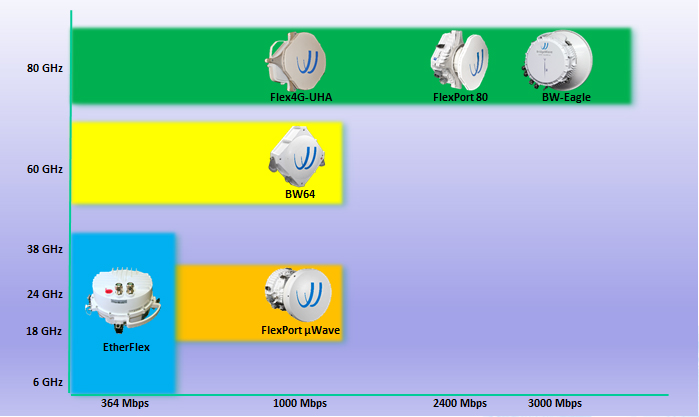
BridgeWave's high capacity wireless products are enabled by innovative transceiver, modem and digital signal processing technologies. BridgeWave's products utilize the licensed microwave radio spectrum in the 6 to 38 GHz range as well as the millimeter wave radio spectrum in the 60 to 80 GHz range, enabling multi-protocol SONET/SDH and gigabit Ethernet wireless connectivity at affordable price points.
|
 |
|
BridgeWave's point-to-point wireless solutions offer high performance, cost-effective alternatives to fiber circuits for mobile backhaul, service provider, enterprise network extensions, and government / municipal network applications.
BridgeWave's wireless backhaul solutions provide fiber-equivalent connections between locations by transmitting data over microwave or millimeter wave frequencies with speeds from 100 Mbps to multi-gigabit with the advantage of add/drop data ports, Ethernet switching and optional wire-speed FIPS-certified 256-bit AES encryption built-in.
Our 60 GHz backhaul solutions yield full-duplex Fast Ethernet or gigabit Ethernet connectivity with optional AdaptRate™ for short range applications.
Our 80 GHz backhaul solutions yield full-duplex data rates up to 3 Gbps while providing TDM + IP, Advanced Ethernet switching and Ethernet OAM management required for backhaul of next-generation 4G and LTE networks.
Our 6 – 38 GHz microwave backhaul solutions are ideal for customers looking for medium to high-capacity connectivity at extended distances. These all-outdoor solutions are hardened for the most demanding environments, while requiring no indoor space.
Whatever your connectivity requirements, BridgeWave has the right product with the features and performance you need. Easily installed and managed, our family microwave and millimeter wave radio solutions combines high performance, high reliability and low total cost of ownership for years of worry-free performance.
BridgeWave's Advanced Features
- Multi-gigabit Ethernet transmission (FlexPort 80-3000 and Eagle)
- Simultaneous SDH/SONET + Ethernet Transmission (FP80)
- Single microwave frequency ODU for 1 Gbps @ 18/23/24 GHz (FlexPort µWave)
- 256-bit Built-in (optional) Advanced Encryption Standard: the strongest data encryption available for a secure wireless network
- AdaptRate™: BridgeWave's all-weather wireless gigabit technology for availability over multi-mile distances (60 & 80 GHz)
- AdaptPath™: BridgeWave's technology for the highest performance and availability in any weather condition
- Adapt Rate Modulation enables high reliability connectivity during periods of inclement weather (EtherFlex, FP80)
- Embedded 10/100/1000 Ethernet Switch provides add/drop capabilities and detailed Ethernet port statistics
- Advanced Carrier Ethernet transport and management capabilities (FP80, FP80-3000, Flex4G-UHA, Eagle)
- Ethernet OAM Management (802.3ah, 802.1ag, Y.1731 – FP80, FL4G-UHA, Eagle)
- SyncE & 1588v2 (FP80, FL4G-UHA, Eagle)
BridgeWave's solutions meet the following stringent regulatory requirements:
- RF: U.S. FCC Part 15.255; U.S. FCC Part 101; EN 302 217; Industry Canada RSS-210
- Safety: UL Listed; CE Mark; EN60950; Meets FCC 1.1310 general population and EN62311 MPE limits
- EMC/EMI: FCC Part 15, Class B; EN 301 489-1; EN 301 489-4
- Environmental: EN 300 019
- Government: Optional FIPS certified encryption; JF-12; TIC Compliant; IPV6; conforms to IMOD specification; Section 508; and BAA/TAA Compliant
- Other: RoHS, WEEE
60 GHz Family - BW64, BW64E
- 100 Mbps to 1000 Mbps
- AdaptRate
- AdaptPath
- 2-port Ethernet switch for add/drop
- FIPS Certified 256-AES Encryption
- Distances up to 1 mile/1.6 km
80 GHz Family - FL4G-UHA, FP80, FP80-3000, Eagle
- Up to 3000 Mbps
- AdaptRate
- AdaptPath
- Carrier-grade gigabit Ethernet switch with support for copper and fiber interfaces
- Ethernet OAM management
- 256-AES Encryption with optional FIPS certification
- Distances up to 5 miles/8 km
6 - 38 GHz Family - EtherFlex, FlexPort µWave
- 6 – 38 GHz, highest system gain for all-outdoor microwave solution
- Up to 1000 Mbps in a single ODU
- QPSK – 256 QAM with Adapt Rate Modulation
- Power-over-Ethernet
- Gigabit Ethernet switch
- Distances up to 30 miles/50 km
|
|
|